Milky Way galaxy meets the sea in Mauritius
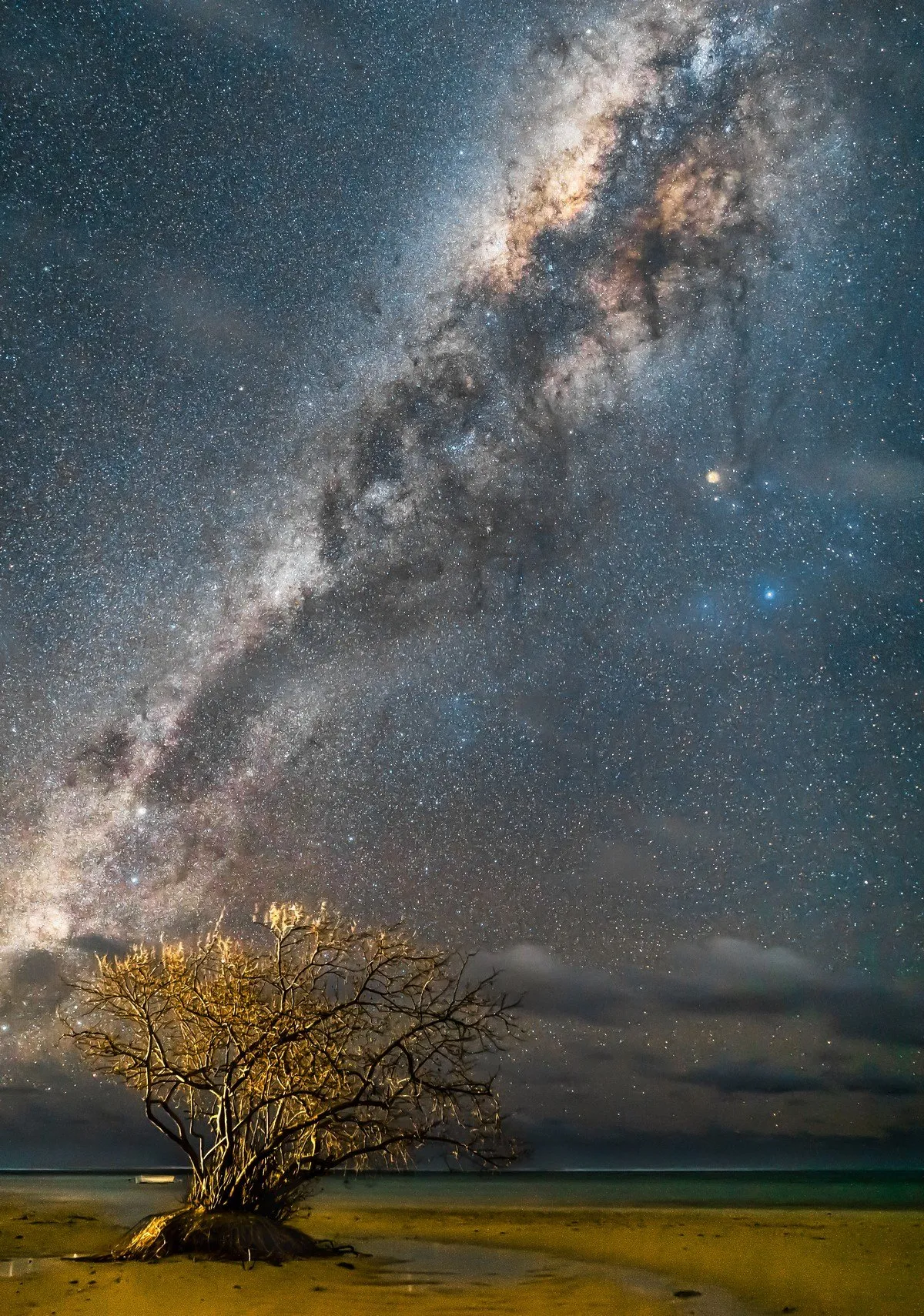
A spectacular panoramic view of the Milky Way galaxy photographed at La Prairie in Mauritius in 2020. The famous old tree of La Prairie beach stands beneath a night sky filled with countless sparkling stars, creating a powerful contrast between the fragile beauty of the landscape and the vastness of the universe. Captured with a DSLR camera, this Milky Way core photograph shows one of the most magical night-sky scenes in Mauritius.
A tree is slowly dying beneath the immensity of the celestial sphere. Erosion continues its silent work, gradually uprooting it and leading it towards an inevitable end. Yet this cycle unfolds under the gentle glow of the stars, whose light reaches us after travelling across unimaginable distances. Some of those stars may have disappeared long before their light finally touches our eyes — perhaps even before life appeared on Earth.
Isn't there something humbling about that? Everything that fades, changes, or disappears on Earth remains part of a much larger balance. From the infinitely large to the infinitely small, everything is cycle, everything is movement, everything is transformation.
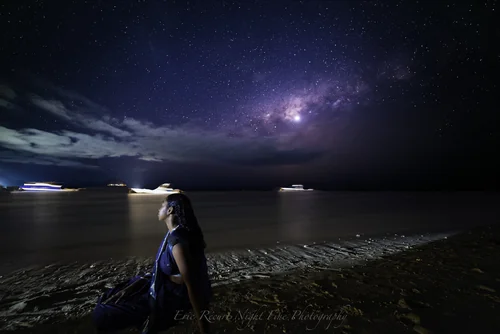
If you love the starlit magic of La Prairie, you may also enjoy our latest Milky Way couple photoshoot in Mauritius — an intimate session blending emotion, maternity, and night-sky photography in Mauritius.
How to Shoot the Milky Way
To photograph the Milky Way, shoot in Manual mode and use RAW format. If you are creating a panorama, keep the white balance manual and consistent across all images. Your shutter speed will depend on your lens and focal length. As a general rule, you can use the 300 rule: divide 300 by your focal length to reduce visible star trails. For example, I usually use around 10 seconds with a 28mm lens.
Use manual focus. Start by focusing close to infinity, then slowly adjust the focus until the brightest star appears as small and sharp as possible. For aperture, avoid shooting fully wide open if your lens is not at its sharpest there. Closing down by half a stop to one stop can often improve sharpness. ISO will depend on your camera's low-light performance. If you are shooting with a Sony A7S, for example, you can comfortably experiment with ISO 10,000 or 12,800.
For a Milky Way panorama, shoot each frame with around one-third overlap. This gives the stitching software enough information to merge the images properly. You can first edit one photo in Lightroom, then sync the same settings across the full series. After that, select all the images and send them to Photoshop as layers, or use the panorama merge option, depending on your workflow and software version.